

 Since Thanksgiving I have been inspired to read and learn as much as possible about hummingbirds. Winter hummers in the Southeast are almost always Selasphoras rufous (Rufous) hummingbirds. Rufous hummers typically over-winter in Mexico and breed/nest in the Pacific Northwest – as far north as Alaska. But over the last 10 years or so, according to experts such as Bob Sargent at the Hilton Pond Center in Rock Hill, SC and also Susan Campbell, researcher at the NC Museum of Natural Sciences, Rufous hummers have been seen during winter at feeders in the Southeast. Information from their websites and other birding websites has been very helpful to me. But no one seems to know for sure why these little birds are visiting the Southeast. It’s hard for me to imagine this tiny bird traveling over 3000 miles to my garden, but I am honored that she is here!
Until early December, our flowers were still blooming and provided plenty of nectar along with the sugar water feeders. Joy was happily zooming from feeder to feeder and flower to flower. But by mid to late December when temperatures were consistently below 28F, the flowers were gone and the sugar water was frozen. Most of the east coast experienced very cold temperatures and we were no different here in SC. Our garden thermometer registered 12F lows with highs around freezing or less. These consistently low temperatures are unusual for South Carolina and I could not help but think Joy chose the wrong winter to visit us! I confess I stayed awake at least a couple of nights worried about whether or not she would freeze to death and I prayed for her to be ok. My maternal instinct wanted to bring her inside or build her a warm little house to keep her safe, but according to Susan, the best thing I could do is keep her “nectar” available. So, each morning before dawn, I bundled up and made the short trek to my office to prepare her sugar water feeders. At first light, I was outside with feeders hung, waiting and watching and listening for Joy. Sure enough, as if by magic, each morning, around 7:10am-7:20am I’d hear her chit-chit, chit-chit as she would zoom in to the feeder near her favorite Monsieur Tillier rose. I would breathe a sigh of relief and send thanks to the universe for keeping her safe another night.
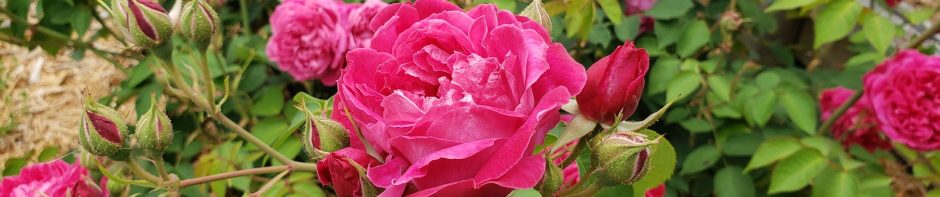
Joy’s favorite Monsieur Tillier rose is big – nearly eight feet by eight feet. She likes to perch and chit-chit in this rose bush much of the day. She also enjoys perching in the huge Belinda rose which is where I first saw her. My Belinda rose is close to 12 feet tall and 15 feet wide. Earlier blogs have pictures of both Belinda and Monsieur Tillier. Another favorite spot is in the Sarah van Fleet which is close to the sugar water feeder in the Secret Garden. She and the other birds – cardinals, chickadees, house finch – seem to feel protected in the many thorny branches of these rose bushes. I have wondered if she roosts at night in one of these bushes, but it’s hard to know for sure since she seems to appear out of the air every morning. I have tried to figure it out for weeks. I’ve watched carefully from several different locations, but never can tell precisely where she has spent the night.
Hummers need nectar from flowers, but also require insects for protein and other nutrients. Even when the temperatures are below freezing, hummers are very resourceful at finding insects. But these little birds have also adapted to the availability of sugar water feeders and may rely on them for survival – particularly in winter. I’m not sure what would have happened to Joy if the sugar water feeder had not been available each morning. Would she have found another food source? Would she have survived? I’ll never know for sure, but it is perfectly clear to me that we have shared a wonderful and mutually beneficial relationship this winter.
As the days and weeks have gone by, I’ve continued this morning routine even though the weather most days is well above freezing and I don’t need to monitor the feeders as closely. Going into the garden before dawn is something I look forward to each day. I quietly listen, watch, and wait as our world wakes up. At first light, I hear the cardinals and chickadees begin the chirp, chirp – chirp, chirp. The cardinals, one by one, fly to the pergola with the Lady Banks Rose and soon there are dozens on the nearly bare branches that look like red Christmas tree ornaments. Soon after the chickadees and cardinals begin to gather and the sky is turning a lovely shade of peachy pink, Joy magically appears for her morning “nectar”. Zooming in for a quick sip sip, she then perches for a while in her Monsieur Tillier rose bush and we have our early morning “chit-chit chat”.

So, how long will she stay in my garden? Susan the researcher said perhaps as long as March when she decides it’s time to go back to the Northwest to find a mate. I do hope she will stay until March and I also hope she will revisit next winter.
But one thing is certain, I have learned so much about life from this tiny, yet brave and tenacious bird. Perhaps one of the most important lessons for me is to always remember that Joy can be found in my garden! The gift of her joyous, colorful, resourceful spirit will always be with me.
Happy New Year with Love and Joy!
Angie

What an inspiring story. Joy does seem tenacious and wise – and I love that you have helped her survive the cold winter. I have never heard of torpor before – thank you for enlightening me. I didn't know they had such a way to survive cold weather in that way – I guess it's like a mini-hibernation. I'm so glad you shared this story – the image of you waking up at dawn with Joy and the other living things there is quite pure and positive.